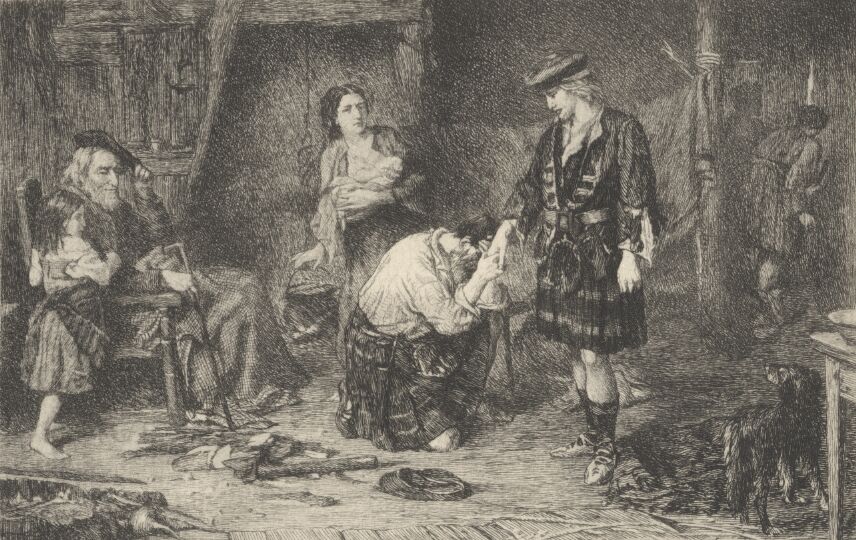
There is a curious linguistic sleight of hand at the heart of how modern societies deal with cultural minorities. Groups that were once feared — suppressed by military force, stripped of their languages, their dress, their social structures — have a habit of reappearing, a century or two later, as objects of tender concern. What was dangerous becomes endangered. What was violently destroyed gets lovingly preserved. My new article, published in a special issue of Anthropological Quarterly devoted to the question of perspective in linguistic anthropology, examines this transformation through a specific and revealing case: the Scottish Highlands, the Gaelic language, and Walter Scott’s novel Waverley (1814).
The Battle That Changed Everything
In April 1746, at the Battle of Culloden, the Jacobite uprising was crushed. The rebellion, which had briefly threatened to overturn the emerging British capitalist order, was defeated, and with it, a whole way of organising social life. The British state moved swiftly: Highland dress was banned, clan authority abolished, the Gaelic-speaking population displaced through the Clearances that followed over the next century.
The Highlanders were, at this moment, genuinely dangerous in the eyes of the British state. Not because of some imagined primitiveness, but because they represented an alternative: an alternative form of authority rooted in loyalty, kinship, and a non-liberal conception of political obligation. Jacobitism was not simply nostalgia for the Stuarts, but also a different way of thinking about who had the right to rule and why.
Enter Walter Scott
When Scott published Waverley in 1814, the military threat was long over. But something subtler was underway. Scott’s novel, the most widely read work of fiction of its era, performed a remarkable ideological operation. It took the Highland world, acknowledged its nobility and power, and framed it as irrevocably past. The Highlanders in Waverley are brave, loyal, vivid — and doomed. Their defeat is presented not as a political act but as a kind of natural process, as inevitable as the turning of seasons.
Crucially, language is central to this operation. Scott’s treatment of Gaelic in the novel is telling: it appears as ambient sound, merged with the landscape — the murmur of a song like the sound of wind at a distance. Gaelic is beautiful, poetic, but also unintelligible. It is emphatically not a language of governance, trade, or political negotiation. It is the language of a vanishing world, to be admired precisely because it is vanishing.
From Dangerous to Endangered
This is the shift I trace in my article, drawing on the work of anthropologist Michel-Rolph Trouillot. There is a profound asymmetry between dangerous and endangered that we rarely notice. To be dangerous is to be dangerous to someone: it implies a relationship, a political conflict, a real threat to an established order. To be endangered is simply to be, it is intransitive, apparently natural, stripped of political agency. The Highlander shifts from being a threat to the British state to being a fragile relic in need of state protection.
This shift is not neutral. It is part of what we called perspectival regimentation in the special issue: a process by which the political stakes of a conflict are dissolved, and replaced by a discourse of cultural heritage. The communities whose ways of life were violently dismantled become, in this new framework, custodians of a precious but fading tradition. They are invited to preserve what was taken from them, but only in forms acceptable to the dominant order. The language may survive as poetry and song. Not as the medium of an alternative politics.
The Trap of Modernity
This is the trap that minority language communities find themselves in today. Language revitalization movements are, in many ways, genuinely emancipatory: they do resist erasure, they affirm dignity, they build communities. But they also operate within a framework they did not create and cannot entirely escape. To make the case for a minority language, you must argue simultaneously that all languages are equal (a universalist claim) and that this language is uniquely irreplaceable (a particularist claim). You must speak the language of rights and heritage — the language, in other words, of liberal modernity — in order to be heard.
This is not a reason to abandon language revitalization. But it is a reason to be clear-eyed about what these movements are working within and against. The road from Culloden to Gaelic Medium Education runs through Walter Scott, through the aestheticization of a world that was first destroyed, then mourned, then carefully managed.
What was dangerous does not simply become endangered. It is made endangered, through ideological work that takes generations and produces texts, images, laws, and institutions. Understanding that process is the first step toward imagining something beyond it.